0.20.x
0.20.6b1
- Released:
19.02.2026
- pre-release:
✨ New Features
Dead link validation during indexing
Outgoing links from needs are now validated against the index during indexing. When a link targets a non-existent need ID or part ID, a
needs.dead_linkdiagnostic is emitted. Validation supports incremental updates, so only affected links are re-checked when needs change.Individual link types can opt out via the
allow_dead_linksoption on the link definition.Fine-grained lint suppression by path and message
Two new
[lint]configuration options allow targeted suppression of diagnostics:lint.per-file-ignores— suppress specific diagnostic codes for files matching glob patterns:[lint.per-file-ignores] "tests/**/*.rst" = ["needs.dead_link", "needs.invalid_field_value"]
lint.message-ignores— suppress diagnostics whose message contains a given substring, optionally scoped to specific codes:[[lint.message-ignores]] codes = ["needs.invalid_field_value"] contains = "deprecated_field"
These complement the existing
lint.ignore(global code suppression) andlint.lsp_select(LSP-only override) options.needs.links configuration
Added a new dict-based
[needs.links]configuration format for defining link types, as an alternative to the existing array-based[[needs.extra_links]]format. This aligns with the upcoming sphinx-needs v7 release (sphinx-needs#1649).[needs.links.implements] incoming = "is implemented by" outgoing = "implements" [needs.links.tests] incoming = "is tested by" outgoing = "tests" copy = true
👌 Improvements
Expanded real-time schema validation in the editor
Quick schema validation for LSP diagnostics now checks a much broader set of JSON Schema constraints beyond enum values, including
minLength,maxLength,minimum,maximum,minItems,maxItems,uniqueItems, andconst. Link values are also now validated in real-time.
🐛 Fixes
Fixed
parse_variants = trueon core fields (status,tags,title) being incorrectly rejected when the field was not listed invariant_options. This now matches sphinx-needs behavior, which allows variants on these fields by default.
0.20.5b1
- Released:
16.02.2026
- pre-release:
👌 Improvements
Schema validation alignment with sphinx-needs
Schema validation now includes
docname,is_external, andis_importfields in the need JSON representation, enabling schemaselectclauses to filter by these properties. All defined link fields are now included in validation (even when empty), making link constraints likeminItemsvalidate consistently across all needs.Deterministic diagnostic ordering
Diagnostics related to needs are now emitted in a reproducible order, sorted by ID.
0.20.4b1
- Released:
10.02.2026
- pre-release:
✨ New Features
Schema definition validation now runs during indexing
The
needs.schema_definitions_from_jsonschema validation is now integrated into the indexing process, validating needs against your JSON Schema definitions automatically as you edit. Previously, this validation was only available via the CLI.This emits diagnostics with severity-specific codes:
needs.schema_definition_info- informational schema rulesneeds.schema_definition_warning- warning-level schema rulesneeds.schema_definition_violation- critical schema violationsneeds.schema_network_info- informational network/link rulesneeds.schema_network_warning- warning-level network rulesneeds.schema_network_violation- critical network violations
See Schema validation configuration for more details.
Regex support in need query syntax
Added
search()function and regex matching syntax (=~) to the need query language, enabling powerful pattern matching when querying needs. String literals now also support escape sequences for special characters.Field specialization with
needs.fieldsconfigurationA new
needs.fieldsconfiguration allows you to define specialized field schemas, enabling fine-grained validation of need extra options with JSON Schema. Fields now default to nullable with no default value, providing more flexibility.This will support the future sphinx-needs v7 release.
👌 Improvements
Schema validation speed and robustness
Schema validation now uses forward link expansion for better incremental performance, reducing re-validation overhead when editing needs.
Schema validation now handles errors gracefully without raising exceptions
Improved error messages for field schema compilation errors
Fixed array type injection in schema validation
Improved
ubc schema validateCLIThe
ubc schema validatecommand now has a consistent user experience withubc build index, including improved progress output and error reporting.MCP server improvements
Fixed crash when
query_needswas called by Claude modelAdded aliases to
SortDirectionfor improved usability
Needs graph view fixes
Fixed “Focus on main need” button and zoom behavior in the needs graph view.
‼️ Breaking Changes
Removed deprecated Kuzu database support
The Kuzu graph database feature (introduced in v0.9.0) has been removed due to Kuzu being deprecated. The following have been removed:
ubc build json-to-kuzucommandkuzuformat option fromubc build needs(-f kuzu)
If you were using Kuzu databases, consider migrating to the
parquetorjsonformats instead.
🐛 Fixes
Fixed edge-case “ID already registered” errors in VS Code caused by duplicate links in LSP endpoints.
0.20.3b1
- Released:
27.01.2026
- pre-release:
✨ New Features
Enhanced Need schema validation
Comprehensive schema validation for need extra options and extra links has been added to the indexing process.
These diagnostics emit the codes:
needs.invalid_field_valueneeds.invalid_link_value
See Fields configuration.
Grouping support in Needs Index tree view
The Needs Index view now supports grouping needs by different properties (e.g., type, status, tags), making it easier to organize and navigate large sets of needs.
Click-to-source navigation in RST preview
Clicking on elements in the RST preview now navigates directly to the corresponding source location in your editor.
Scroll sync toggle for RST preview
A new toggle allows you to enable or disable scroll synchronization between the RST source and preview.
CLI configuration override option
New
-c/--configCLI option andUBCODE_CONFIG_OVERRIDEenvironment variable allow overriding configuration settings directly from the command line.See CLI documentation for more details.
Warning on missing image/figure files
The indexer now warns when image or figure directive files are missing, helping catch broken references early.
This diagnostic emits the code
image.not_foundcode.Source follow links configuration
New
source.follow_linksconfiguration option to control how source file links are resolved. See source.follow_links configuration for more details.
👌 Improvements
Need Viewer enhancements:
Added back/forward navigation with history support
Added zoom controls for better readability
Added “Go to Source” context menu action
Improved performance with batch LSP endpoint for node data
RST preview toolbar modernization
The RST preview toolbar has been updated to match the aesthetic of the Needs View.
Improved RST autocompletion for need directive options
Better autocompletion suggestions when editing need directive options in RST files.
Improved diagnostic location reporting
Diagnostic warnings for
needs.statusesandneeds.tagsnow report more accurate source locations.Improved MCP server handshake
Fixed compatibility issues with the VS Code MCP server handshake.
Needs Index tree view optimization
Reduced server calls for improved performance when browsing needs.
Schema file handling
The indexer now warns on missing schema files rather than erroring, improving resilience.
License CLI improvements
Added
ubc license config-filecommand and--useroption toubc license show.Extension version in home tree view
The VS Code extension version is now displayed in the home tree view for easier identification.
🐛 Fixes
Fixed race condition in Windows cache directory creation.
Fixed race condition in the
openNeedViewcommand.Fixed missing VS Code configuration options not being registered.
‼️ Breaking Changes
Removed deprecated Kuzu database support
The Kuzu graph database feature (introduced in v0.9.0) has been removed due to Kuzu being deprecated. The following have been removed:
ubc build json-to-kuzucommandkuzuformat option fromubc build needs(-f kuzu)kuzuPython dependencykuzu_need_table_cmdRust function and Python binding
If you were using Kuzu databases, consider migrating to the
parquetorjsonformats instead.
0.20.2b1
- Released:
10.12.2025
- pre-release:
👌 Improvements to filtering
Within needs.global_options predicate filters, needimport and needextend filters,
the needs.filter_data configuration can now be used to define additional variables for use in filter expressions.
Within needs.global_options predicate filters, needextend filters, additionally, the docname variable is now available.
For needextend this is derived from the document path containing the directive,
and for needs.global_options it is derived from the document path the need is defined in, for need and needimport directives.
The docname is the path relative to project.srcdir, without the file extension (as per Sphinx’s standard document naming).
This improves compatibility with sphinx-needs filtering.
For example:
project.srcdir = "docs/source"

[needs.filter_data]
my_var = "a"

[needs.global_options.status]
default = "open"
predicates = [
  ["my_var == 'a'", "closed"]
  ["docname == 'index'", "other"],
]
.. needextend:: docname == 'some_doc' and my_var == 'a'
   :status: another
👌 Additional improvements
The
copykey ofneeds.extra_linksitem configurations is now supported, as per the logic of sphinx-needs. See Extra links configuration for more details.Improvements to the Model Context Protocol (MCP) server: The need query input and return value schemas, and usage instructions, have been improved, to allow for easier interpretation by LLMs and reduce token usage.
Addition of the
--deny-externalsoption to theubc diffcommand. This filters out external needs from the diff analysis, which is helpful when reviewing Git history, to focus only on local project changes, and to avoid false positives when externalneeds.jsonfiles are dynamically generated and may not be available.If projects use dynamically generated external
needs.jsonfiles, e.g. build via Bazel, those will not be available when runningubc diff gitor before Bazel was called. The feature can be used to avoid false positives.
🐛 Fixes
Diagnostic warnings for unknown variables in
needextendare now correctly captured and emitted. For example:.. needextend:: unknown_variable == 'value' :status: closed
ublicense: Fix machine code handling for recent versions of Windows 11
0.20.1b1
- Released:
17.11.2025
- pre-release:
🔧 Fixes
This pre-release fixes an issue with the deployment of the last pre-release, whereby for some platforms incorrect binaries were bundled with the VS Code extension.
0.20.0b1
- Released:
12.10.2025
- pre-release:
New and Improved
✨ Enhanced Type Safety with Sphinx-Needs v6 Compatibility
ubCode now includes comprehensive typing support to mirror sphinx-needs v6.
This includes:
Added
schemaoption to the need extra options configuration, allowing you to define and enforce value types for custom need fieldsFull type validation for need extra options (string, bool, int, float, and list variants)
Improved handling of nullable extra options for more flexible need definitions
Type-aware filtering and querying of needs
For example:
[[needs.extra_options]]
name = "effort"
description = "Story points (Fibonacci sequence)"

[needs.extra_options.schema]
type = "integer"
enum = [1, 2, 3, 5, 8, 13, 21, 34]
description = "Must be a Fibonacci number"
See Fields configuration for more details.
✨ Ontology Schema Validation
New (experimental) CLI command
ubc schema validateprovides comprehensive validation of your project’s need schema and ontology:Validates need type definitions against configured schemas (using the
needs.schema_definitions_from_jsonconfiguration)Checks consistency of extra options and their types across the project
Ensures compliance with ontology rules and constraints
Provides detailed error reporting for schema violations
ubc schema validate
See the Configuration and CLI documentation for more information.
✨ Model Context Protocol (MCP) Server Integration
The VS Code extension now includes a built-in MCP server that provides:
Programmatic access to project needs and metadata
Query interface for external tools and AI systems
See the MCP server documentation for more details on using the MCP server.
✨ Enhanced Graph View with Extended Depth
Significant improvements to the need graph visualization:
Added toolbar with configurable maximum distance buttons for exploring need relationships
Extended depth graph traversal for better visualization of complex need hierarchies
You can also now open the needs graph view directly from a need directive in your rST files, or from the command pallete.
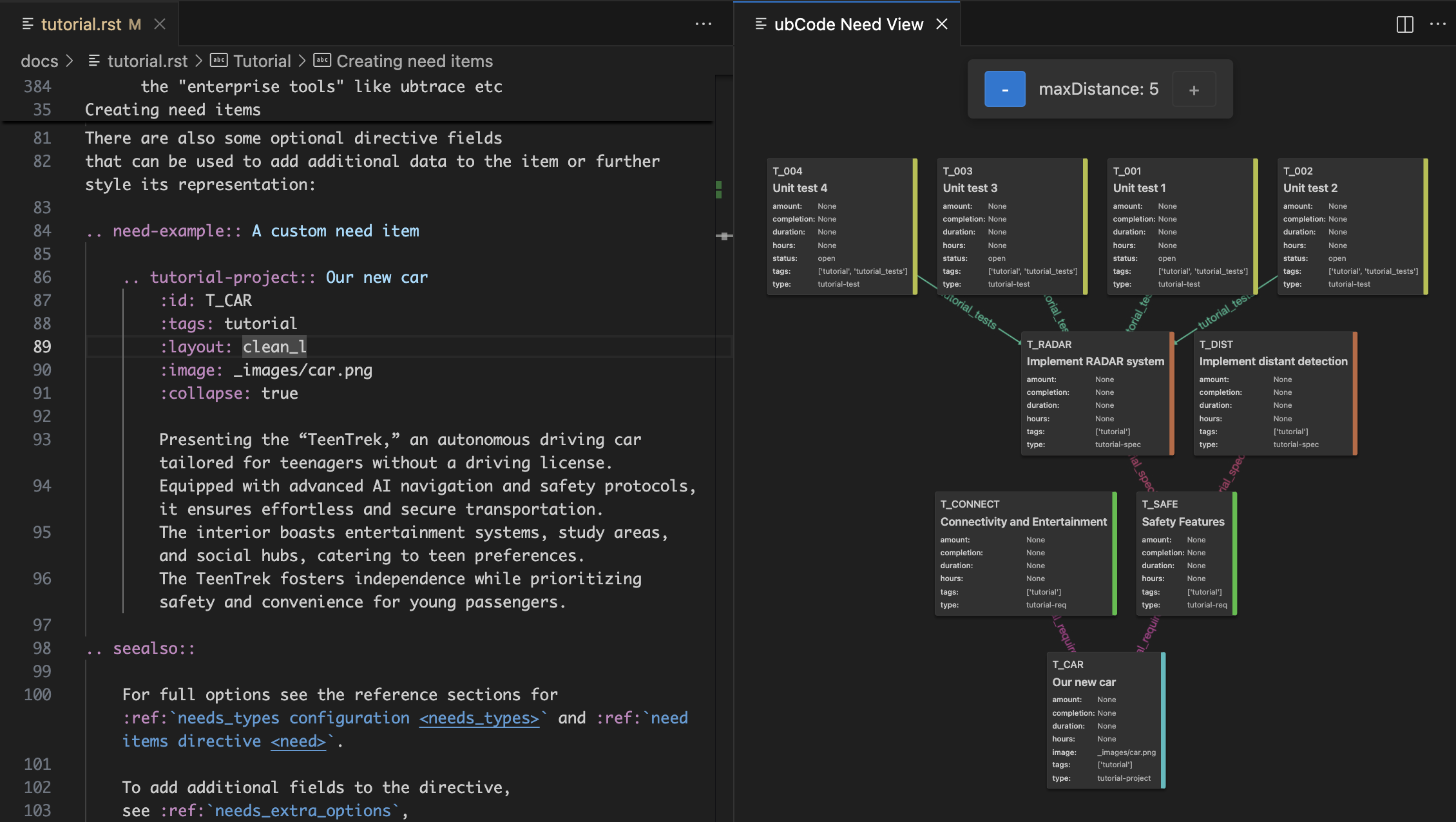
Needs Graph View
See the needs graph view documentation for more information on using the graph view.
✨ Project Comparison with Diff Command
New CLI command
ubc diffenables comparison of schemas and needs between two projects:Compare need schemas across different project versions
Identify differences in need definitions, types, and configurations
Export comparison results in multiple formats
Useful for project evolution tracking and compatibility checking
Capability to look into the Git history
See the CLI documentation for more information.
ubc diff --project project1/ --project project2/
ubc diff --format html -o report.html --project project1/ --project project2/
ubc diff --needs _build/needs.json --project project2/
ubc diff git
✨ Advanced Filtering Syntax
Expanded filtering capabilities with new syntax support:
Variable-to-variable comparisons
Support for
len(var)expressions in Python queriesEnhanced string operations like
"text" in var.upper()Improved type handling for
list[bool]variables
See the Filtering documentation for more details.
✨ Variant Options Configuration
Added
needs.variant_optionsconfiguration option:Define variant-specific need option sets
Support for conditional need field configurations
Enhanced flexibility in multi-variant documentation projects
Improved variant syntax parsing from sphinx-needs
variant_options = ["status", "priority", "assignee"]
See the Variants configuration for more details.
✨ Improved JSON Import/Export
Enhanced handling of needs data in JSON format:
Better support for importing needs with complex type structures
Improved error handling when importing needs with invalid field types
More robust JSON export capabilities for needs data
Enhanced testing and validation of JSON import/export workflows